

In recent years, the skin microbiota has gone from being a concept largely confined to the scientific sphere to becoming a prominent topic in cosmetic discourse. More and more brands are talking about “microbiota-respecting,” “microbiome-friendly,” or “balancing” products, presenting this approach as the new frontier of skincare.
However, as with any emerging trend, the growing interest in the skin microbiota has been accompanied by simplifications, imprecise messaging, and, in some cases, promises that are not always technically sustainable. This raises a key question for today’s cosmetic development: what does it really mean to formulate with the skin microbiota in mind?
From the laboratory perspective, the microbiota is not approached as a marketing argument, but as one more dimension of skin balance. Understanding its role, its limits, and its relationship with the skin is essential to developing products that are coherent, effective, and responsible.
The skin microbiota is not a passing trend, but neither is it a universal solution. It is a complex field that requires judgment, technical knowledge, and a realistic view of what cosmetics can—and cannot—do.
Why the Skin Microbiota Is Relevant Today
The skin is not a sterile surface. It is home to a wide community of microorganisms—bacteria, fungi, and others—that naturally coexist with our skin cells. This community, known as the skin microbiota, plays a key role in maintaining skin balance.
For a long time, cosmetic approaches were dominated by a hygienist mindset focused on eliminating microorganisms. Today, this paradigm has evolved. It is now understood that the presence of a diverse and balanced microbiota is fundamental to skin health.
The current relevance of the skin microbiota can be explained by several factors that have converged in recent years:
- Advances in scientific research, allowing for a better understanding of the interaction between skin and microorganisms.
- An increase in skin issues related to imbalance, such as sensitivity, irritation, or recurrent flare-ups.
- A shift in consumer expectations, with a growing demand for gentler, more respectful products.
- Questioning of overly aggressive routines, both in cleansing and treatment.
From this new perspective, the microbiota is understood as a functional ally of the skin, not as an enemy to be eliminated. It contributes to reinforcing the barrier function, modulating inflammatory responses, and protecting against external aggressions.
However, it is important to clarify that the microbiota is not the same in all individuals or across all areas of the body. Its composition varies depending on multiple factors:
- Anatomical area
- Age
- Skin type
- Environment and lifestyle
- Cosmetic routine
This variability means that there is no single “ideal microbiota,” but rather dynamic balances that change over time. From a laboratory standpoint, this is a key point in avoiding simplistic messages or universal solutions that do not reflect the biological reality of the skin.
Cosmetics and Skin Balance
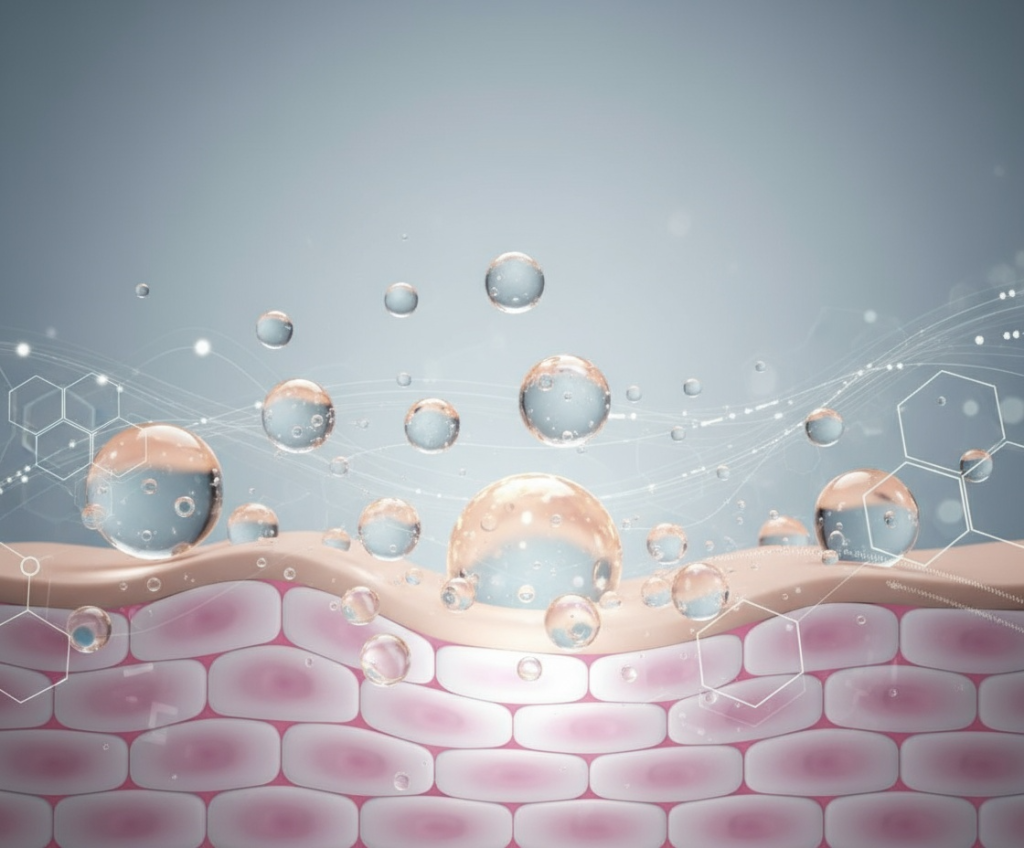
Talking about the skin microbiota in cosmetics necessarily means talking about balance. The skin is a complex ecosystem in which cells, lipids, water, and microorganisms interact. When this balance is disrupted, visible signs of skin discomfort may appear.
Cosmetics play a direct role in this ecosystem. Every product applied to the skin has the potential to influence this balance, either positively or negatively. For this reason, formulating with the microbiota in mind does not mean “adding something” in isolation, but rather evaluating the overall impact of the formulation.
From the laboratory’s perspective, certain cosmetic factors can disrupt skin balance if not properly managed:
- Overly aggressive cleansing systems
- Inappropriate pH for daily use
- Excessive use of ingredients with antimicrobial activity
- Formulas that compromise the skin barrier
When these factors accumulate, the skin can become more reactive, more sensitive, and less tolerant—even to products that are, in theory, well formulated.
In this context, cosmetics aimed at supporting skin balance seek to minimize unnecessary aggression and promote an environment in which the skin can self-regulate. This does not mean sacrificing efficacy, but rather rethinking how that efficacy is achieved.
A product that respects skin balance is not necessarily less active, but it is usually designed with a different logic:
- It prioritizes tolerance and comfort over the medium and long term
- It avoids overwhelming the skin with unnecessary stimuli
- It takes continued use into account, not just immediate effects
From this perspective, the microbiota becomes another indicator of skin condition, not an isolated target. The ultimate goal is not to “modify the microbiota,” but to create favorable conditions for the skin ecosystem to function in a stable way.
This approach requires abandoning quick fixes and embracing a more systemic view of personal care, where each formulation decision has implications beyond the immediate benefit being communicated.
Ingredients Oriented Toward Microbiological Respect
When discussing microbiota-respecting cosmetics, one of the areas that draws the most attention is ingredient selection. However, from the laboratory’s point of view, it is important to clarify that there are no miracle ingredients that, on their own, guarantee microbiological balance.
Respect for the microbiota does not depend solely on incorporating certain actives, but on how those ingredients are integrated into the formula and on the overall set of technical decisions that accompany them.
That said, there are families of ingredients that, when properly used, can contribute to formulations that are more compatible with skin balance:
- Ingredients that help maintain the skin barrier, reducing water loss and protecting the cutaneous environment.
- Actives with soothing or modulatory action, which help reduce skin reactivity.
- Components that support a physiological pH, compatible with the skin and its microbiota.
Beyond specific ingredients, the microbiota-oriented approach focuses as much on what is avoided as on what is added. Reducing the unnecessary use of broad-spectrum antimicrobial ingredients, when they are not essential to the product’s function, is one of the most relevant decisions in this type of formulation.
It is also essential to analyze the impact of preservative systems, surfactants, and other functional components which, although necessary, may affect the skin ecosystem if not carefully selected and dosed.
From the laboratory’s perspective, working with ingredients oriented toward microbiological respect involves:
- Evaluating their compatibility within the complete formula
- Considering their cumulative and long-term use
- Analyzing their impact on overall product tolerance
This approach requires technical judgment and a deep understanding of formulation as a system. It is not about following a list of “approved” ingredients, but about formulating with a logic of balance, where each component fulfills a clear and justified function.
In this sense, the skin microbiota does not redefine cosmetics from scratch, but it does require greater awareness of the long-term impact that products have on the skin.
Technical Challenges in Formulation
Formulating cosmetic products with a microbiota-respecting approach involves facing a series of real technical challenges that go beyond conceptual discourse. Although interest in this approach is growing, its practical application requires a delicate balance between efficacy, stability, safety, and tolerance.
One of the main challenges is that the skin microbiota is not an isolated system—it constantly interacts with the skin and with the products applied to it. Any change in formulation can have indirect effects that are difficult to predict if the system is not evaluated as a whole.
Among the most common challenges encountered in the laboratory are:
- Balancing microbiological respect with product preservation. Every cosmetic product requires an effective preservative system to ensure microbiological safety. The challenge lies in selecting systems that protect the product without unnecessarily disrupting skin balance.
- Precisely and consistently controlling pH. Small variations in pH can affect both formula stability and skin tolerance, as well as the microbiological environment.
- Maintaining product efficacy. Respecting the microbiota does not mean giving up visible results. The challenge is to formulate effective products without relying on aggressive or destabilizing stimuli.
Another critical aspect is long-term stability. Ingredients oriented toward skin respect may be more sensitive to temperature changes, oxidation, or interactions with other components. This requires rigorous stability and compatibility testing.
In addition, microbiota-oriented formulation often requires a more holistic view of the product. It is not enough to add or remove ingredients; it is necessary to review:
- The type of emulsion or delivery system
- The intended frequency of use
- The context of the cosmetic routine in which the product will be used
From the laboratory’s perspective, one of the greatest risks is oversimplifying this approach. The microbiota does not respond to standard formulas or universal solutions, which is why each development must be evaluated on a case-by-case basis.
For this reason, formulating with microbiological criteria often means accepting that this is not always a fast or immediate path, but rather a more thoughtful process, where each technical decision has medium- and long-term implications.
Responsible Communication Versus Hype
One of the major current challenges in microbiota-related cosmetics is not only technical, but communicative. Growing interest in this field has created an environment in which imprecise messages, exaggerated promises, and poorly defined concepts proliferate.
From the laboratory’s perspective, it is essential to establish responsible communication that does not distort scientific reality or create unrealistic consumer expectations. The skin microbiota is a complex and dynamic system, and reducing it to simplified messages can be counterproductive.
Some of the most common communication mistakes regarding the microbiota include:
- Presenting it as a system that can be easily “controlled” through a cosmetic product.
- Attributing global effects to specific ingredients without sufficient evidence.
- Using scientific terminology without a solid foundation to support it.
Such messaging may generate short-term interest, but in the medium term it undermines the credibility of both the brand and the microbiota-based approach itself.
From a responsible standpoint, communicating about the microbiota means focusing on what the product actually does, rather than on what sounds most innovative. In many cases, this involves talking about balance, tolerance, and skin respect rather than promising radical transformations.
The laboratory plays a key role in this process by helping brands to:
- Define claims that are coherent with the real formulation
- Avoid unjustified extrapolations from limited data
- Translate complex technical concepts into clear and honest language
Responsible communication does not diminish product value; on the contrary, it strengthens it. In an increasingly informed market, consumers value clarity, coherence, and transparency over grandiose claims.
Moreover, this approach protects the brand from potential regulatory or reputational challenges, especially in a field as sensitive as the use of microbiota-related terminology.
Speaking about the microbiota with rigor does not mean eliminating narrative—it means building it on solid foundations, aligned with what the product can realistically deliver.
Real Opportunities for Innovation
Beyond media noise, the skin microbiota represents a genuine opportunity for innovation when approached through technical knowledge and product strategy. This is not about reinventing cosmetics, but about refining them and making them more consistent with the skin’s natural functioning.
One of the main opportunities lies in rethinking formulation approaches, prioritizing long-term tolerance and continued use over aggressive, immediate-impact strategies. This shift aligns particularly well with brands seeking to position themselves in conscious, dermatological, or daily-care segments.
From the laboratory’s perspective, microbiota-related innovation can take shape at different levels:
- Development of formulas that reinforce the skin barrier as the central axis of care
- Products designed for reactive, sensitized, or environmentally stressed skin
- Reformulation of existing products to improve skin compatibility without altering brand identity
There is also a clear opportunity in consumer education. Explaining why certain products aim not to “do more,” but to respect skin balance, helps build a more mature relationship between brand and user.
When properly understood, the microbiota encourages a move away from over-stimulation and toward more balanced routines. This opens the door to more rational product ranges, well-formulated multifunctional products, and messaging less dependent on fleeting trends.
From a strategic standpoint, brands that integrate this approach coherently tend to differentiate themselves not through the novelty of the claim, but through the consistency of their proposition.
True innovation lies not in adding labels, but in developing products that perform better over time, are well tolerated, and support the skin rather than forcing it.
Conclusion: Formulating with Judgment in a Complex Field
The skin microbiota represents one of the most interesting—and complex—areas in contemporary cosmetic development. It is not an empty trend, but neither is it a universal solution. It is a field that demands knowledge, caution, and a solid technical perspective.
Formulating with the microbiota in mind means accepting technical challenges, making careful decisions, and communicating responsibly. It also means rejecting shortcuts and oversimplified narratives in favor of products that are coherent, effective, and aligned with the skin’s real functioning.
At MS Lab, we understand this approach as a natural evolution of personal care: a more conscious, respectful, and strategic way of formulating. It is not about promising more, but about formulating better, integrating the microbiota as part of skin balance rather than as an isolated argument.
In a market saturated with messages, true differentiation will come from a brand’s ability to develop products that stand the test of time—both in results and in credibility.Because in cosmetics, innovation does not always mean doing something new, but doing it with greater judgment.

