


In today’s cosmetic industry, efficacy has become one of the central pillars of brand communication. Consumers are no longer satisfied with generic promises or empty aspirational messages—they want results, coherence, and evidence to support what a product claims to do. In this context, validating the real efficacy of a cosmetic product before launch is not optional; it is a prerequisite for competing with credibility.
However, efficacy is neither a simple nor a single-dimensional concept. From the outside, it may be perceived as a visible result or a tangible improvement in the skin. From the laboratory’s perspective, efficacy is the outcome of a complex technical process that begins long before the product reaches the consumer and involves strategic, methodological, and communicative decisions.
Understanding how cosmetic efficacy is validated allows brands to make better decisions, avoid unnecessary risks, and build messages aligned with the reality of the product. Because efficacy is not improvised—it is designed, measured, and substantiated.
What Efficacy Really Means in Cosmetics
One of the most common mistakes in cosmetics is using the term “efficacy” in a generic way, without clearly defining what it means in each specific case. In everyday language, efficacy is often associated with “working.” In a cosmetic context, however, this definition is insufficient.
From a technical standpoint, cosmetic efficacy refers to a product’s ability to perform the function it claims under normal conditions of use and on the target audience for which it is intended. This means the product must demonstrate that it delivers the benefit it communicates—not merely suggest it.
It is important to understand that efficacy is not a single concept, but can be approached at different levels:
- Functional efficacy, related to measurable parameters such as hydration, smoothness, or elasticity.
- Perceived efficacy, linked to user experience, sensoriality, and first impressions.
- Medium- or long-term efficacy, particularly relevant for treatment products.
All of these levels are part of the overall product experience, but not all are validated in the same way, nor do they carry the same weight when communicating benefits.
From the laboratory’s perspective, efficacy is always assessed in relation to the complete formulation, not just individual actives. An ingredient may have strong scientific evidence, but if it is not properly integrated into the formula—at the right concentration and within a stable system—its final efficacy may be compromised.
Efficacy must also be understood in context. A moisturizing cosmetic is not evaluated in the same way as an anti-aging product, nor is a daily care product assessed like an intensive treatment. Each category requires specific evaluation criteria, and applying generic metrics often leads to conclusions that are either unhelpful or outright incorrect.
For this reason, talking about real efficacy means going beyond commercial discourse and entering the realm of technical development and rigorous validation.
What Tests Are Used and What They Are For

Cosmetic efficacy validation relies on different types of tests, each with a specific purpose. Not all tests serve the same function, nor are they all necessary for every project. The key lies in defining what needs to be demonstrated and selecting the appropriate methodology.
Among the most common tools are instrumental tests, which provide objective and quantifiable data. These tests measure specific parameters using specialized equipment and are particularly useful when substantiating concrete functional benefits.
Examples of what these tests may evaluate include:
- Skin hydration levels
- Skin elasticity or firmness
- Transepidermal water loss
- Surface texture or homogeneity
Alongside instrumental testing, consumer use tests or user studies are also conducted to capture subjective perception after a controlled period of application. Although they do not produce instrumental numerical data, they are essential for evaluating acceptance, sensoriality, and coherence between what the product promises and what users perceive.
In certain cases—especially when products are intended for sensitive skin or specific conditions—dermatological evaluations under professional supervision are carried out. These studies help support claims related to tolerance, skin compatibility, or suitability for reactive skin.
From the laboratory’s perspective, a crucial part of the process is not only conducting the tests, but correctly interpreting the results. Not all data can be directly communicated, and not all positive outcomes justify a commercial claim. Understanding the scope and limitations of each test is essential to avoid misleading or exaggerated messaging.
Moreover, efficacy testing should not be viewed as an isolated final step. In many developments, results influence subsequent decisions such as:
- Adjusting active concentrations
- Partial reformulation of the product
- Reconsidering positioning or the main benefit communicated
Validating efficacy is therefore a dynamic process that accompanies development, not a formality added at the end.
How Product Claims Are Substantiated
Claims are the bridge between the laboratory and the consumer. They are the statements that communicate product benefits and directly influence purchasing decisions. For this reason, substantiating them properly is one of the most critical responsibilities in cosmetic development.
From the laboratory’s standpoint, a claim is only valid when there is sufficient evidence to support it. This evidence may come from different sources, provided they are coherent with the final product:
- Results from instrumental tests
- Consumer use studies
- Dermatological evaluations
- Bibliographic evidence correctly applied to the formulation
One of the most frequent mistakes is defining claims before validating the product, and then attempting to fit the results into a pre-established message. This approach often creates tension between development and marketing and increases the risk of launching weak or poorly supported claims.
Substantiating a claim also requires precisely defining what is being stated. Saying that a product “hydrates” is not the same as stating that it “increases skin hydration by X% after X days of use.” The more specific the claim, the higher the level of evidence required to support it.
In addition, claims must be clear, honest, and aligned with the consumer’s real experience. A technically correct message that is poorly expressed can generate frustration if users do not perceive what is promised.
At MS Lab, claim development is understood as a joint process between technical development and brand strategy. The goal is not to accumulate benefits, but to build messages that reflect the reality of the product, add value, and reinforce consumer trust.
Because in cosmetics, saying less—but saying it with solid backing—is often far more effective than promising more than a product can deliver.
What Happens When Results Are Not as Expected
In cosmetic development, not all efficacy results confirm initial expectations right away. Far from indicating failure, this situation is part of the real validation process. The difference between a solid development and a problematic one lies not in avoiding unexpected results, but in how they are interpreted and what decisions are made as a result.
When an efficacy study does not deliver the expected outcomes, the laboratory evaluates the project as a whole before drawing conclusions. In many cases, the issue does not lie in the product concept itself, but in technical variables that can be adjusted—such as concentrations, active synergies, delivery systems, or even study design.
It is also common to encounter a misalignment between the benefit being pursued and what the product can realistically deliver. Some expectations are more aligned with a pharmaceutical approach than a cosmetic one, or are not coherent with the product format, usage conditions, or application timeframe.
In these situations, several paths may be considered:
- Adjusting the formula to reinforce the desired benefit
- Reframing the claim to align with what can be demonstrably supported
- Reviewing the evaluation methodology to ensure it is appropriate
- In specific cases, delaying the launch until identified limitations are resolved
From the laboratory’s perspective, unexpected results are understood as strategic information, not obstacles. They allow the product to be improved, the narrative refined, and promises that would not hold up in the market to be avoided.
Forcing a launch when efficacy is not properly supported often carries higher medium-term costs: returns, negative reviews, and loss of credibility. Managing this phase correctly is therefore one of the most responsible decisions a brand can make.
The Role of the Laboratory in Validation
The laboratory is not merely a test executor—it is the core of the efficacy validation process. Its role extends beyond generating data to interpreting it, contextualizing it, and turning it into actionable decisions for the brand.
From the earliest stages of development, the laboratory helps define:
- Which benefits are technically viable
- Which parameters can be objectively measure
- Which types of tests provide real value to the project
This early definition is essential to avoid unnecessary or poorly designed studies that generate costs without delivering meaningful insights.
During validation, the laboratory acts as a technical and regulatory filter, assessing whether the results obtained are consistent, reproducible, and sufficient to support the messages the brand wants to communicate. Not every positive result can automatically become a claim, and not every claim adds value for the consumer.
Another key role is the translation of technical data into understandable language. The laboratory interprets complex results and converts them into clear information so that the brand can make informed strategic decisions without losing rigor or falling into misleading simplifications.
The laboratory also supports the brand when course corrections are needed. Reformulation, repeated testing, or redefining objectives are all part of a well-managed validation process. In this sense, the laboratory does not push for rushed launches, but safeguards the coherence between product, message, and final user experience.
When the laboratory is integrated as a strategic partner, validation stops being an isolated phase and becomes a central axis of cosmetic development.
Efficacy, Trust, and Brand Reputation
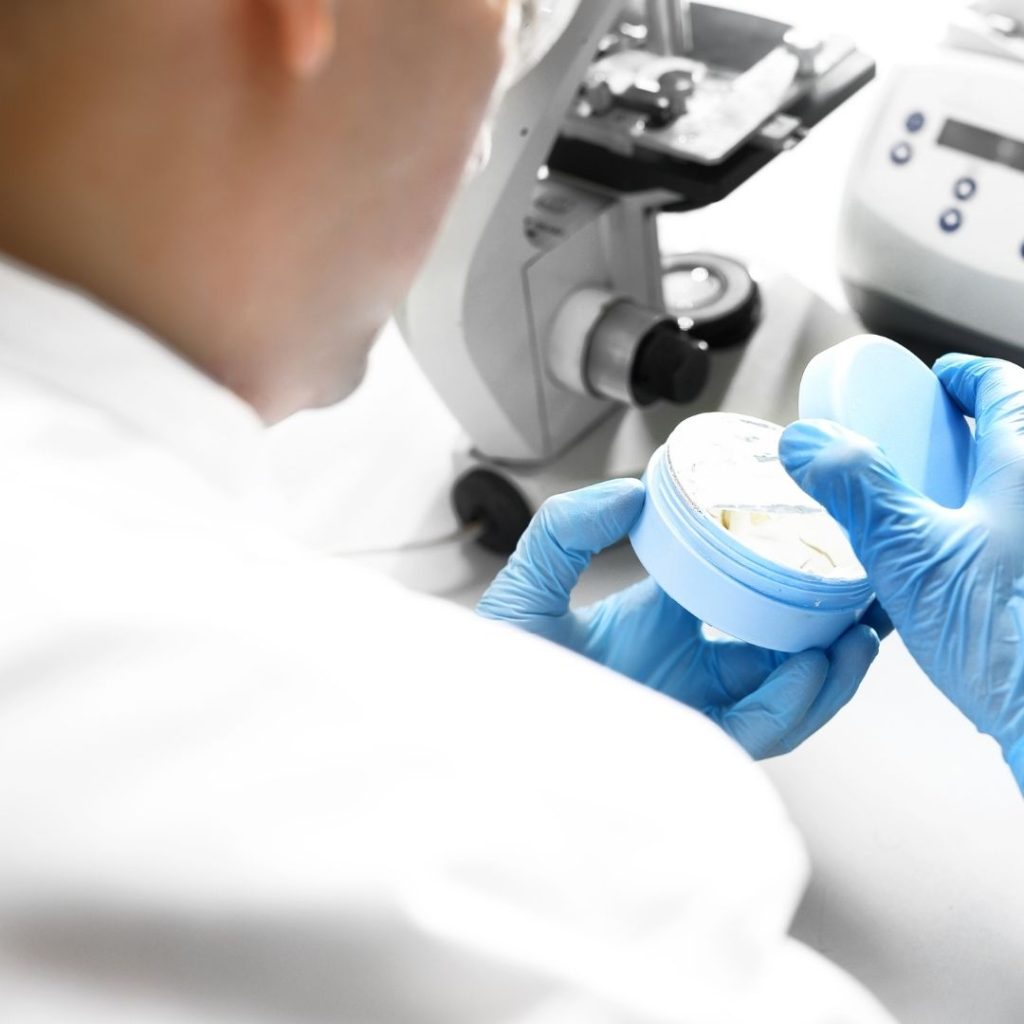
The efficacy of a cosmetic product does not end with laboratory validation. Its true impact is measured when the product reaches the consumer and becomes part of their daily routine. It is at this point that efficacy connects directly with trust and brand reputation.
A product that delivers on its promises strengthens brand credibility. When consumers perceive coherence between messaging, user experience, and results, a relationship of trust is built that goes beyond a single product launch.
Conversely, when claims are not properly substantiated, the risk is not limited to isolated criticism, but to a gradual erosion of brand reputation. In an environment where opinions spread quickly, unfulfilled promises have a cumulative effect.
From a strategic perspective, proper efficacy validation enables brands to:
- Build stronger, more sustainable brand narratives
- Reduce the risk of returns and complaints
- Stand out in a market saturated with similar claims
- Foster long-term loyalty based on real results
Efficacy thus becomes an intangible asset. It may not always be immediately visible, but it directly influences perceived quality, product recommendation, and the brand’s ability to grow consistently.
Brands that commit to rigorous validation tend to communicate fewer promises—but more credible ones. And this distinction is increasingly valued by informed and demanding consumers.
Conclusion: Validating to Launch with Credibility
Validating the efficacy of a cosmetic product is far more than a technical requirement before launch. It is a strategic process that connects development, communication, and consumer experience.
Understanding what efficacy truly means, how it is measured, what happens when results do not meet expectations, and the role of the laboratory allows brands to make more conscious and responsible decisions.
At MS Lab, we understand validation as a collaborative process in which technical expertise supports strategy and every data point serves a clear purpose. It is not about promising more, but about promising better, aligning communication with product reality.In an increasingly demanding market, well-validated efficacy not only protects the brand—it strengthens it. Because trust is not built through bold statements, but through results that stand the test of time.

