


Scaling a cosmetic brand or entering new international markets is often seen as the logical next step after an initial phase of commercial validation. When a product performs well, sales grow, and the brand gains visibility, it is common to assume that growth is simply a matter of increasing volume or replicating the same model in other countries. In practice, however, growth is one of the most delicate stages in the development of a cosmetic brand.
One of the most frequent mistakes is confusing commercial growth with real cosmetic manufacturing capacity. Selling more does not automatically mean being prepared to produce more, comply with new regulatory requirements, manage more complex logistics, or maintain product quality at a larger scale. When this distinction is not analyzed in time, growth stops being an opportunity and becomes a source of operational problems, delays, and cost overruns.
From the experience of laboratories and manufacturers, many brands reach the scaling phase with a fragile technical foundation: formulas developed without considering large volumes, poorly optimized processes, or excessive dependence on a single supplier or a single formulation. These issues may go unnoticed in early stages but become critical when volume increases or when the product needs to be adapted to new markets.
This scenario is especially common among brands that work with a private label cosmetics manufacturer in their early stages and, after validating the product in a local or digital market, decide to grow quickly. If that growth is not supported by a solid industrial strategy, limitations appear sooner than expected.
In addition, international expansion adds an extra layer of complexity. Each market has its own regulations, quality expectations, documentation requirements, and logistical constraints. Attempting to scale without reviewing these factors often leads to bottlenecks that slow down—or even halt—expansion.
In this article, we analyze the most common structural mistakes cosmetic brands make when trying to scale or grow internationally, starting with one of the most critical—and at the same time most underestimated—errors: scaling without first validating the product’s industrial viability.
Scaling Without Validating the Product’s Industrial Viability
One of the most serious—and most common—mistakes in growth processes is attempting to scale a product without first validating its real viability in terms of cosmetic manufacturing. Many brands assume that if a product works at a small scale, it will work the same way when volume increases. Industrial reality is very different.
When a Formula “Works” but Is Not Scalable
In early stages, a formula may be perfectly suitable for small or medium production runs. However, as volume increases, problems begin to appear that were not detected during initial development:
- Difficulty reproducing the formula consistently
- Excessive sensitivity to process variations
- Inefficient manufacturing times
- High production losses
These issues are not always related to product quality, but rather to its industrial design. A formula developed only with the final result in mind—and not its large-scale manufacturing—often shows limitations when scaling is attempted.
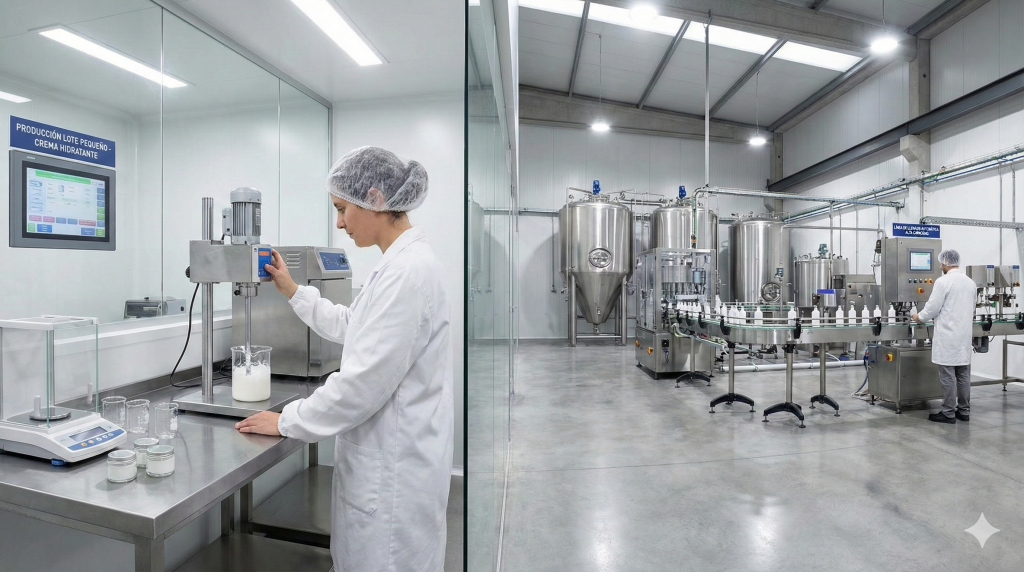
Higher-Volume Production: New Rules of the Game
As a brand grows, cosmetic manufacturing stops being a relatively flexible process and starts requiring:
- Standardized, repeatable processes
- Strict control of critical parameters
- Optimization of time and resources
- Rapid response capacity to incidents
A formula that requires very specific conditions, difficult-to-handle raw materials, or weak processes can quickly become a bottleneck when scaling.
The Mistake of Not Testing Growth Scenarios
Many brands fail to evaluate how their product will behave under different growth scenarios. Key questions that are often not asked include:
- Can the product be manufactured in much larger batches without losing quality?
- Is the process cost-efficient as volume increases?
- Are there technical limitations that prevent scaling beyond a certain point?
- What happens if demand multiplies in a short period of time?
When these questions are not addressed in advance, growth can be hindered by industrial issues that could have been avoided.
Dependence on Inflexible Processes
Another common mistake is developing products with excessively rigid manufacturing processes. This may be due to:
- Use of very specific technologies
- Dependence on particular equipment
- Manual processes that are difficult to automate
In early stages, these limitations may seem manageable. However, when volume increases or production needs to be transferred to other plants, they become a barrier to growth.
An experienced private label cosmetics manufacturer often warns about these risks, but they are not always integrated into the brand’s strategy from the beginning.
Costs That Spiral as You Scale
Another clear sign of unvalidated industrial viability is uncontrolled cost increases as the brand grows. Contributing factors often include:
- Formulas not optimized for large volumes
- Raw materials with limited negotiation leverage
- Long or inefficient processes
- Frequent reprocessing requirements
In these cases, selling more does not always mean earning more. In fact, many brands discover that their margins shrink as volume increases, compromising the sustainability of growth.
The Laboratory’s Role in Industrial Validation
One of the key advantages of working with an experienced laboratory or private label cosmetics manufacturer is their ability to evaluate a product’s industrial viability before scaling.
This involves analyzing:
- Formula robustness
- Process reproducibility
- Real scalability of ingredients
- Impact of volume on costs and timelines
When this analysis is carried out in time, the brand can make informed strategic decisions: adjusting the formula, optimizing processes, or redefining its growth plan before problems arise.
Scaling Without an Industrial Base: An Avoidable Risk
Attempting to scale without validating industrial viability is not only a technical risk, but also a strategic one. It can lead to:
- Delays in international launches
- Inability to meet demand
- Loss of quality or consistency
- Damage to brand image
The good news is that this mistake is avoidable. Integrating an industrial perspective from early stages allows brands to build a solid foundation for sustainable and controlled growth.
Not Adapting Formulation and Documentation to New Markets
One of the most frequent—and most costly—mistakes when a cosmetic brand decides to grow internationally is trying to replicate exactly the same product in all markets. What works in one country, in a specific channel, or at small scale does not always remain valid when geographic reach expands.
Many brands assume that if the formula is well developed and the product sells, it is enough to translate the label or make minimal documentation adjustments. However, from a cosmetic manufacturing perspective, each market introduces technical, regulatory, and documentary variables that cannot be ignored.
Regulatory Differences That Directly Affect the Product
Each country or region applies its own regulatory framework. This means that a formulation valid in one market may require adjustments—or may not even be viable—in another.
Common differences include:
- Lists of permitted or restricted ingredients
- Different concentration limits for certain components
- Varying interpretations of claims and benefits
- Specific safety and evaluation requirements
When brands do not anticipate these differences, they are forced to modify the formulation reactively, leading to delays, cost overruns, and in some cases, inability to enter certain markets.
The Mistake of Assuming Documentation Is “Universal”
Another common error is underestimating the level of documentation adaptation required for international growth. A cosmetic product dossier is not always directly transferable between markets.
Aspects that often require adaptation include:
- Safety reports and toxicological assessments
- Claim justification and substantiation
- Languages and formats required by authorities
- Pre-market notification or registration requirements
From the experience of a private label cosmetics manufacturer, many brands discover these requirements when the project is already advanced, forcing them to redo documentation and slowing growth.
One Formula for All Markets: Is It Always Viable?
Trying to maintain a single global formulation may seem efficient, but it is not always realistic. In some cases, laboratories recommend:
- Adjusting concentrations for specific markets
- Replacing certain ingredients
- Developing slightly adapted versions of the same product
Failing to do so can severely limit expansion or force compromises that affect efficacy, stability, or product perception.
The Laboratory’s Role in International Adaptation

A laboratory experienced in cosmetic manufacturing acts as a strategic filter at this stage. Its role is not only to adapt the formula, but to help the brand decide:
- Which markets should be prioritized
- Which adaptations are truly necessary
- When it makes sense to keep a single formula and when it does not
This perspective avoids improvised decisions and supports more structured, sustainable growth.
Underestimating the Logistical and Regulatory Impact of Growth
Another very common structural mistake among brands seeking to scale or internationalize is underestimating the impact of logistics and regulation on day-to-day operations. In early stages, these aspects may seem secondary to product or marketing, but as volume grows, they become critical factors.
Logistics as a Growth Bottleneck
As a brand scales, logistics shift from being an operational issue to a strategic one. Common problems when this phase is not properly planned include:
- Delivery delays due to poor forecasting
- Increased transportation costs
- Difficulty managing inventory across multiple countries
- Incompatibilities between product, packaging, and transport conditions
From a cosmetic manufacturing perspective, these problems usually stem from lack of early planning and from not designing the product with large-scale distribution in mind.
Regulation Is Continuous, Not One-Off
Many brands treat regulation as a one-time requirement, when in reality it is an ongoing process. As international growth progresses, regulatory workload increases proportionally:
- More markets mean more regulatory updates
- Regulatory changes affecting already-launched products
- Continuous need to keep documentation up to date
Without a structure capable of supporting this load, legal and commercial risks arise that can abruptly halt growth.
Hidden Costs of Failing to Anticipate These Factors
Underestimating logistics and regulation often leads to hidden costs that appear once the brand has already scaled:
- Penalties for non-compliance
- Product withdrawals or market block
- Emergency solution cost overruns
- Loss of trust from distributors and partners
These costs are particularly difficult to absorb when the brand is in a rapid growth phase.
The Importance of a Solid Industrial Base
Both logistics and regulation are directly linked to the project’s industrial foundation. Working with an experienced private label cosmetics manufacturer allows brands to:
- Design products with scalability in mind
- Anticipate logistical and regulatory requirements
- Adjust processes before volume increases dramatically
This does not eliminate the complexity of growth, but it significantly reduces associated risks.
Growing Without Structure: A Recurring Mistake
Many brands attempt to grow by relying on solutions that worked in early stages, without reassessing whether they remain valid. The result is often a fragile structure that cannot withstand increased volume or international complexity.
Planning logistics and regulation from the beginning is not an added burden—it is an investment in sustainability.
Relying on a Single Formula or a Single Supplier
Another common structural mistake among scaling cosmetic brands is building growth entirely around a single formula or a single supplier. In early stages, this dependence may seem logical and even efficient, but as the brand grows, it becomes an operational, industrial, and strategic risk.
Many brands start with a “hero product” that accounts for most sales. The issue is not having a bestseller, but failing to build a structure capable of sustaining growth without excessive reliance on a single pillar.
The Risk of a Single Formula as the Basis for Growth
When a brand depends on one formula to scale, any issue affects the entire business. Common risks include:
- Supply problems with a key raw material
- Regulatory changes forcing reformulation
- Stability issues detected at larger scale
- Limitations when adapting the product to new markets
From a cosmetic manufacturing standpoint, the more volume a single formula concentrates, the greater the impact of any unforeseen event. What was manageable in early stages can lead to production stoppages or significant losses during growth.
Lack of Flexibility to Adapt to New Markets
When a brand relies on a single “closed” formulation, international adaptation becomes much more complex. Instead of adjusting the product strategically, the brand attempts to force the same formula into all markets.
This often results in:
- Abandonment of high-potential markets
- Last-minute improvised adaptations
- Compromises in claims or positioning
- Delays in international launches
An experienced private label cosmetics manufacturer usually recommends diversification or, at minimum, designing formulas with adaptation margins from the start—something many brands overlook.
Dependence on a Single Supplier: A Silent Risk
Reliance on a single supplier is another recurring mistake. In early stages, working with one laboratory or manufacturer may simplify management, but as the brand scales, this dependence can create major bottlenecks.
Common risks include:
- Insufficient production capacity during demand peaks
- Dependence on a single plant or location
- Limited negotiation power on costs
- Difficulty switching suppliers if issues arise
From a cosmetic manufacturing perspective, diversification does not necessarily mean working with many suppliers, but rather avoiding building growth around a single point of failure.
The Mistake of Not Planning Alternatives

Many brands do not plan alternative scenarios until a problem occurs. They fail to evaluate options such as:
- Secondary sources for raw materials
- Approved alternative suppliers
- Adapted versions of the same formula
When an issue arises, the response is often late and costly—especially during international expansion.
How This Dependence Affects Real Scalability
Relying on a single formula or supplier limits a brand’s ability to scale sustainably. In the long term, this can lead to:
- Slower-than-expected growth
- Greater vulnerability to external changes
- Difficulty attracting international distributors or partners
An overly rigid structure restricts expansion, even when demand exists.
The Laboratory’s Role in Sustainable Cosmetic Growth
Across all the mistakes analyzed so far, one common factor emerges: the lack of an integrated industrial and strategic vision from the start. In this context, the role of the laboratory goes far beyond formulation or manufacturing.
A laboratory with experience in cosmetic manufacturing becomes a key partner in supporting sustainable brand growth.
The Laboratory as a Risk Evaluator
One of the main values a laboratory provides is its ability to identify risks before they become real problems, including:
- Evaluating formula scalability
- Detecting critical dependencies
- Anticipating regulatory and logistical impacts
- Analyzing the industrial viability of growth
This analysis enables brands to make informed decisions and avoid structural mistakes.
Support Beyond Formulation
A private label cosmetics manufacturer does more than develop products; it can support brands in decisions such as:
- Phased launch planning
- Adapting products for new markets
- Optimizing production processes
- Defining an industrial roadmap
When the laboratory becomes part of the project, growth shifts from reactive to strategic.
Building an Industrial Base Ready for Growth
Sustainable growth is not improvised. It requires a solid industrial foundation that includes:
- Robust, adaptable formulas
- Scalable, efficient processes
- Documentation structures prepared for internationalization
- Ability to respond to market changes
The laboratory acts as the guarantor of this foundation, helping brands grow without compromising quality, compliance, or profitability.
From Supplier to Strategic Partner
Brands that grow most solidly are those that view the laboratory not merely as a supplier, but as a strategic partner. This relationship allows them to:
- Anticipate problems rather than correct them late
- Make decisions with long-term vision
- Design products with future evolution in mind
In such a competitive industry as cosmetics, this difference is crucial.
Conclusion: Growth Is Not Just About Selling More
Scaling or expanding internationally is not simply about increasing sales or entering new markets. In cosmetics, real growth is built on a solid industrial, regulatory, and strategic foundation.
Mistakes such as scaling without validating industrial viability, failing to adapt formulation and documentation, underestimating logistics and regulation, or relying on a single formula or supplier arise when growth is pursued without a global view of cosmetic manufacturing.
For brands—especially those working with a private label cosmetics manufacturer—understanding these risks is essential to avoid bottlenecks, cost overruns, and missed opportunities.
The laboratory plays a key role in this process, not only as a technical executor, but as a strategic ally that helps transform growth into something sustainable, controlled, and profitable.Because in cosmetics, growing fast without structure can be just as dangerous as not growing at all.

