

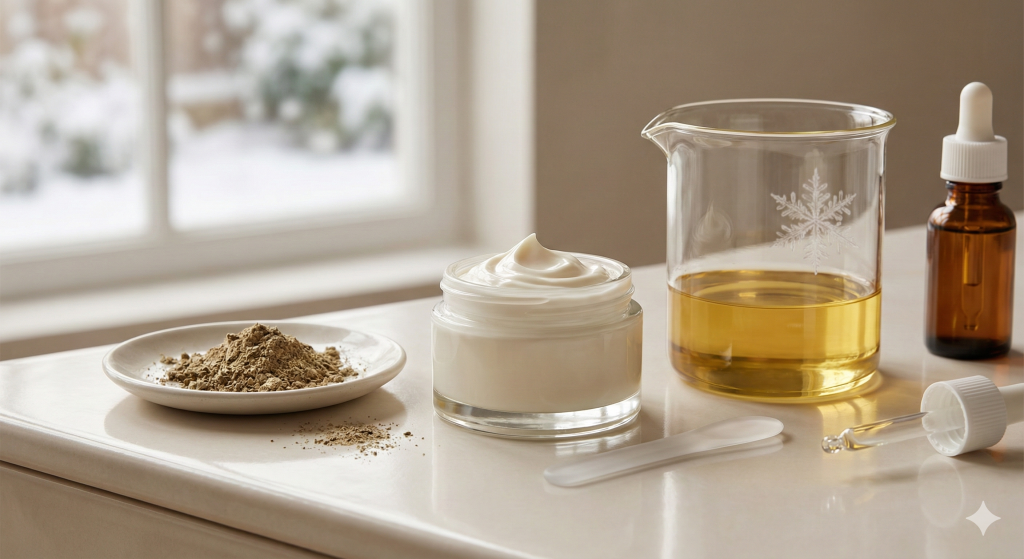
Skin does not behave the same way throughout the year. Although this statement is widely accepted, in practice many cosmetic formulations are still designed according to an “all-season” logic, without fully considering how seasonal changes directly affect skin physiology and, consequently, the real effectiveness of the product.
Winter represents one of the greatest challenges—and opportunities—for cosmetic brands. Low temperatures, reduced ambient humidity, and thermal contrasts between outdoor and indoor environments disrupt the skin’s natural balance, alter its response to products, and change consumer expectations. In this context, adapting formulations is not a matter of trend, but of technical judgment and a deep understanding of the skin.
From the laboratory perspective, seasonal cosmetics are approached as a logical evolution of the product. It is not about reformulating without reason, but about understanding when, why, and how a formulation needs to be adjusted in order to remain effective, comfortable, and consistent with real-life use.
How Skin Changes During Winter
During the colder months, the skin faces a combination of factors that disrupt its natural balance. On a physiological level, winter places greater demands on the skin barrier, compromising its ability to protect the skin and retain moisture.
Among the main changes observed during this season are:
- Reduced lipid production, which weakens the barrier function.
- Increased transepidermal water loss, leading to a stronger sensation of dryness.
- Greater skin sensitivity and reactivity, even in skin types that are not usually problematic.
One of the most noticeable changes is the reduction in lipid production. Cold temperatures decrease sebaceous gland activity, resulting in drier, tighter, and more vulnerable skin. This reduction in lipids directly affects barrier function, facilitating transepidermal water loss and increasing skin sensitivity.
This is compounded by low ambient humidity, especially in urban environments and heated indoor spaces. Dry air accelerates skin dehydration, even in individuals who do not usually experience dryness in other seasons. As a result, flaking, discomfort, and reduced tolerance to certain ingredients or textures may appear.
Winter also tends to intensify skin reactivity. Sudden temperature changes, wind, and exposure to cold can cause:
- Persistent redness
- Irritation and stinging sensations
- More pronounced inflammatory responses
This affects both sensitive skin and skin types that do not typically present issues.
From a laboratory standpoint, understanding these changes is essential to formulate products that not only “work,” but also support the skin during a period of increased vulnerability. Ignoring seasonality means assuming that the skin behaves in a static way, when in reality it is a dynamic organ that continuously responds to its environment.
Why the Same Formula Does Not Work All Year Round
One of the most common approaches in cosmetics is to develop a formula intended to be suitable for year-round use. While this may be viable in some cases, in many others it creates a disconnect between the product and the user’s real experience.
A formula designed for temperate climates or warmer seasons may fall short in winter for several reasons:
- Textures that are too light to provide sufficient comfort
- Hydration systems that are inadequate for low-humidity conditions
- Actives that perform well in summer but respond differently in winter
The result is not always an obvious failure, but rather a gradual perception that the product “no longer works the same way.”
From the laboratory’s perspective, this perception is a clear signal that the formula is no longer supporting the skin in its real context of use. Cosmetic efficacy does not depend solely on the ingredient itself, but on how that ingredient acts on a specific skin type, in a specific environment, at a specific time of year.
Winter also changes consumer expectations. During this season, particular value is placed on:
- Immediate comfort after application
- A sense of protection against external aggressions
- The product’s ability to relieve tightness and discomfort
A formula that feels fresh and pleasant in summer may feel insufficient—or even uncomfortable—during winter.
This does not mean that every season requires a completely new formula. In many cases, it is necessary to reconsider the balance of the formulation: reinforcing certain components, adjusting concentrations, or modifying hydration systems in order to maintain efficacy.
From a strategic standpoint, understanding that the same formula does not always perform equally allows brands to anticipate satisfaction issues and strengthen their positioning as brands that truly understand the skin beyond generic messaging.
Actives That Take Center Stage in Winter
Seasonal change affects not only the skin, but also the role that ingredients play within a formulation. During winter, certain actives gain particular relevance due to their ability to protect, repair, and reinforce the skin barrier.
Among the most relevant groups of actives during this season are:
- Hydrating agents, focused not only on supplying water but on retaining it.
- Lipid-based ingredients, which compensate for the natural reduction in sebum.
- Soothing and repairing actives, which improve skin tolerance.
Hydrating agents remain essential, but in winter their role goes beyond simply delivering water. Humectant actives must work in synergy with ingredients that help retain moisture and reduce transepidermal water loss. The goal is not just hydration, but maintaining hydration in a hostile environment.
Lipid-based ingredients also become increasingly important. Oils, butters, and biomimetic lipids help compensate for the natural reduction in sebum production and restore the structure of the skin barrier. In formulation, their selection and proportion are key to avoiding heavy sensations while still providing protection.
During winter, soothing and repairing actives become especially valuable. Ingredients with anti-inflammatory or regenerative properties help reduce skin reactivity and improve product tolerance—essential when the skin is more exposed to external aggressions.
From the laboratory’s perspective, the selection of winter actives is not based solely on individual efficacy, but on how they interact with each other and with the formula base. Even a suitable active, if poorly integrated, may fail to deliver the expected results or negatively affect sensory perception.
For this reason, adapting actives to seasonality requires a global formulation approach, in which each ingredient fulfills a clear function within a specific context of use.
Textures, Comfort, and Sensory Perception
In cosmetics, efficacy is not measured only by visible results, but also by the user experience. In winter, this dimension becomes even more important, as the skin needs not only the right actives, but also sensations that convey protection, relief, and immediate comfort.
During the colder months, consumers look for:
- Enveloping textures
- A feeling of immediate relief
- Products that “support” the skin against the cold
Textures that feel pleasant and light in summer may feel insufficient in winter, creating the impression that the product “falls short.”
From the laboratory’s perspective, working on winter sensoriality involves adjusting several formulation factors:
- Emulsion structure
- Oil phase composition
- Absorption speed
- The residue left on the skin
The goal is not to make formulas heavier without purpose, but to balance nourishment and comfort without compromising daily usability.
Texture also directly influences perceived efficacy. A product that feels comforting, reduces dryness, and improves skin well-being from the first use reinforces consumer confidence even before medium-term results become visible.
In winter, sensitivity to certain finishes also increases. Sticky sensations, excessive greasiness, or slow absorption are generally less well tolerated. For this reason, laboratory work focuses on refining the sensory experience, ensuring that the product protects the skin without becoming uncomfortable or restrictive in daily routines.
In this context, texture ceases to be a secondary element and becomes a key tool for seasonal adaptation.
Adapting Products Without Rebuilding an Entire Line
One of the most common concerns brands have when discussing seasonal cosmetics is the belief that adapting formulations means completely rebuilding an entire product line. In most cases, this perception does not reflect reality.
From the laboratory standpoint, seasonal adaptation is understood as a strategic adjustment, not a radical reformulation. Often, small, well-considered modifications allow a product to maintain its efficacy and coherence during winter without losing its original identity.
These adaptations may include:
- Reinforcing hydration systems
- Adjusting lipid proportions
- Adding soothing actives on a targeted basis
- Specific work on texture and comfort
Moreover, adaptation does not always require modifying the base formula. In some cases, the solution lies in complementing the range with seasonal support products, such as more nourishing treatments or winter-specific versions that coexist with the main line rather than replacing it.
This approach allows brands to maintain catalogue coherence, optimize resources, and respond to real consumer needs without unnecessary development. From the laboratory’s point of view, it means reading the formula in context, evaluating its winter performance, and proposing proportionate solutions.
The key is understanding that seasonality does not require reinvention every year, but rather evolution with intention.
When It Makes Sense to Launch Seasonal Editions
Not all brands or products require seasonal editions. However, in certain cases, launching a winter-specific proposal can be a strategic decision with high added value.
Seasonal editions make sense when:
- There is a clear need not covered by the regular line
- Climatic conditions directly affect product use
- The brand can clearly communicate the value of the adaptation
From the laboratory perspective, these launches are evaluated based on factors such as consumer profile, frequency of use, sales channel, and coherence with the existing range.
A well-designed winter edition should not be perceived as an opportunistic product, but as a technical and coherent response to a specific context. When this is achieved, consumers do not see it as excess, but as a sign of knowledge and care.
Seasonal editions can also serve as a space for controlled innovation, allowing brands to test new actives, textures, or concepts without altering the core of the permanent range.
That said, for a seasonal edition to succeed, it must be supported by solid technical development and a clear narrative. Winter is not just a temporary excuse, but a real physiological scenario that justifies specific formulation decisions.
Conclusion: Understanding Seasonality to Formulate with Purpose
Seasonal cosmetics are not a passing trend or a one-off marketing strategy. They represent a way of understanding formulation through the real behavior of the skin and its relationship with the environment.
Winter puts both skin and products to the test. Ignoring its effects means assuming the skin is constant, when in reality it is dynamic and sensitive to external changes. Adapting formulations to this reality does not require redoing everything, but rather formulating with intention, context, and coherence.
At MS Lab, we approach seasonal cosmetics as part of a broader technical and strategic vision: understanding when a formula needs adjustment, how to do it efficiently, and which solutions truly add value to both brand and consumer.
Because formulating well in winter is not just about ingredients—it is about understanding the skin, real product use, and the moment in which it is applied. And that understanding is ultimately what makes the difference between a correct cosmetic and a truly relevant one.

